Why Use a Multi Roller Setup for Tube Elongation and Thinning?

Time:2026-09-21 Author:Liam
0%

Tube manufacturers often face a difficult balance: increasing length while reducing wall thickness without creating cracks, wrinkles, or uneven dimensions. This is where the question “why use a multi roller setup for tube elongation and thinning” becomes important. A multi roller system distributes forming pressure around the tube instead of concentrating it at one contact point. The process can support smoother material flow, improved roundness, and more controlled wall reduction. It is especially useful when working with stainless steel, aluminum, copper, or other ductile alloys.

The rollers work together.

Each roller guides a specific part of the tube surface. As the tube passes through the forming zone, gradual deformation can reduce sudden stress changes. Operators may also adjust roller alignment, speed, pressure, and lubrication for different tube sizes. These settings require practical experience. A small alignment error can leave visible marks or produce inconsistent thickness near the tube ends. Inspection tools, including micrometers, ultrasonic gauges, and roundness checks, help verify the result.

The setup is not magic.

It may require higher equipment costs, careful maintenance, and repeated trials before stable production begins. Tool wear can affect accuracy, while unsuitable lubrication may damage the surface finish. Engineers should compare production speed, material behavior, tolerance requirements, and operating risks before choosing this method. This guide examines the working principles, benefits, limitations, and practical control points behind multi roller tube processing. It also questions where the method may be unnecessary, because more rollers do not automatically guarantee better results.
Why Use a Multi Roller Setup for Tube Elongation and Thinning?

What Is a Multi Roller Setup for Tube Elongation and Thinning?

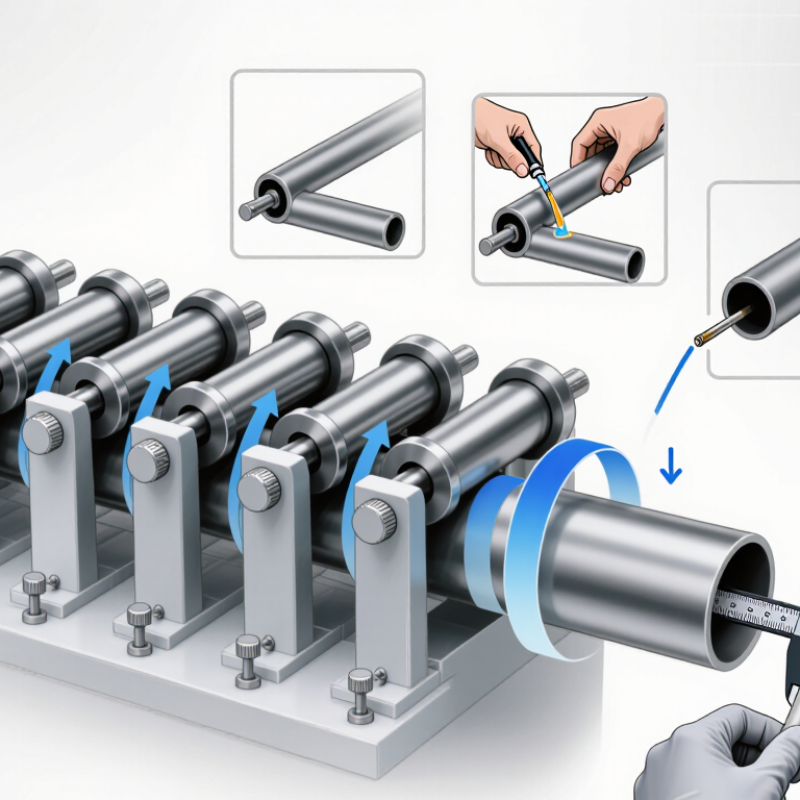
A multi roller setup for tube elongation and thinning uses several rollers arranged around a metal tube. Each roller applies controlled pressure while the tube moves and rotates through the working zone. This action reduces wall thickness and increases tube length without removing material. The process is often called tube sinking or roller reduction, depending on the tooling and whether internal support is used.

A typical setup includes forming rollers, guide elements, a drive system, lubrication, and measuring equipment. The rollers must share the load evenly. Poor alignment can create uneven walls, surface marks, or a slight bend. Operators usually check tube diameter, wall thickness, feed speed, and roller clearance before production. Small changes matter. A difference of a few hundredths of a millimeter may affect the final result.

In practical work, material condition is just as important as machine adjustment. Annealed tubing usually responds more predictably than stressed or contaminated material. I have found that careful lubrication reduces scoring, but it cannot correct incorrect roller geometry. The setup may appear simple, yet heat, friction, and springback complicate control. Some results remain difficult to predict, especially with thin-wall tubes. For reliable production, engineers should compare measured samples with the intended dimensions after each adjustment. Mistakes during setup are useful only when they are recorded and reviewed.

How Multiple Rollers Distribute Forces During Tube Processing

A multi-roller setup controls how forces travel through the tube wall during elongation and thinning. In an ideal three-roller pass, the radial load is shared across three contact zones, rather than concentrated at one point. This reduces local crushing and helps maintain a rounder cross-section. ASM Handbook, Volume 14A, identifies balanced forming loads as a key factor in controlling distortion during bulk metal processing.

The effect is visible on the shop floor. A tube enters the pass with a bright, lubricated surface. Each roller removes a smaller amount of material, while the workpiece advances steadily. Lower force peaks can reduce chatter, surface scoring, and sudden wall-thickness variation. A 2022 study in the Journal of Materials Processing Technology reported that optimized multi-contact forming can lower forming-force concentration and improve dimensional consistency. The exact improvement depends on alloy, reduction rate, roller geometry, and lubrication.

The one-third load rule is only an estimate. Real rollers do not share force perfectly. Small alignment errors can overload one contact area. ISO 6892-1 testing can verify the resulting strength changes, but it cannot reveal every process defect. Operators should also measure ovality at several tube positions, not just at the exit. That extra check often exposes problems hidden by a single diameter reading. According to World Steel Association data, global crude steel output reached about 1.89 billion tonnes in 2023, making small efficiency gains valuable across high-volume tube production.

Why Use a Multi-Roller Setup for Tube Elongation and Thinning?

How multiple rollers distribute forces during tube processing. The chart assumes a constant total radial forming load of 100 kN shared evenly among active rollers.

Increasing the number of rollers reduces the average load carried by each roller. Lower localized force can help distribute deformation more uniformly, supporting controlled tube elongation and wall-thickness reduction while reducing the risk of concentrated marks or excessive thinning.

Key Steps in Controlling Tube Elongation and Wall Thickness

A multi roller setup gives tube elongation a controlled path instead of forcing all deformation through one contact point. Each roller supports part of the reduction, helping distribute pressure around the tube. This matters when wall thickness must remain stable during forming. In practical production, even a small gap difference can create visible variation. Small errors matter.

The process starts with accurate tube preparation. Check the incoming diameter, wall thickness, material condition, and surface cleanliness. Then set the rollers gradually, using measured reductions rather than guesswork. Roller alignment should be verified along the entire forming line. A slight angular error can encourage ovality, local thinning, or surface marking. Measure twice. Adjust once.

Speed, lubrication, and tension also influence the final result. Excessive speed may increase heat and reduce dimensional consistency. Too little lubrication can raise friction, while too much may hide early process problems. Inspect samples after each setup change, preferably at several positions along the tube. Record diameter and wall readings, not only the average value. The first pass may disappoint. That is useful information, not failure. In my experience, stable results come from small adjustments, clear records, and realistic tolerance limits. Operators should also review whether the selected roller sequence matches the material’s strength and ductility. A setup that works for one alloy may behave poorly with another.

Benefits of Multi Roller Systems for Quality and Efficiency

Why Use a Multi Roller Setup for Tube Elongation and Thinning?

Multi roller systems improve quality by sharing deformation across several controlled contact points. During tube elongation, each roller supports the material while reducing wall thickness gradually. This lowers sudden strain and can limit ovality, local buckling, and surface marking.

The scale of production makes control important. The World Steel Association reported 1.89 billion tonnes of crude steel production in 2023. Even small dimensional losses can become expensive at this volume. A multi roller setup helps maintain a steadier outside diameter and wall thickness. Operators can also adjust individual passes instead of correcting one severe deformation later. That flexibility matters.

Small details decide the result.

In practice, technicians check roller alignment, lubrication, feed speed, and temperature before changing reduction settings. A micrometer reading after each pass can reveal drift early. The European Commission’s Ferrous Metals Processing BAT Reference Document emphasizes process control and efficient material use, supporting this measurement-based approach. Still, more rollers do not automatically mean better tubes. Poor synchronization can increase friction, vibration, and maintenance time. That is an easy point to overlook. Plant trials should compare scrap rate, dimensional variation, energy use, and throughput under identical conditions. These measurements provide stronger evidence than catalog claims, especially when producing thin-wall tubes with tight tolerances.

Why Use a Multi Roller Setup for Tube Elongation and Thinning? - Benefits of Multi Roller Systems for Quality and Efficiency
Performance Dimension Single-Roller or Single-Stage Reduction Multi-Roller Setup Practical Benefit for Tube Production
Reduction Distribution Places a larger share of the cross-sectional reduction in one deformation zone. Distributes deformation across several rollers or sequential passes, allowing each contact zone to perform a smaller share of the work. Lower local deformation load
More gradual reduction can improve process stability when the total diameter or wall reduction is substantial.
Tube Elongation Elongation may be more sensitive to friction, tooling alignment, material strength, and the amount of reduction applied in one stage. Progressive reduction supports controlled axial elongation while the tube is drawn or rolled through multiple deformation zones. Improved control
Useful when dimensional growth in length must be balanced against diameter and wall-thickness reduction.
Wall-Thinning Control Higher local deformation can increase the risk of uneven wall reduction, especially with non-uniform lubrication or alignment. Multiple contact points can spread the reduction and provide more opportunities to control wall thickness through roll positioning and pass design. More uniform wall thickness
Actual results depend on tube geometry, material, tooling accuracy, lubrication, and process settings.
Dimensional Consistency Final dimensions depend heavily on one main reduction zone and its setup condition. Several rollers provide repeated geometric guidance and correction during the reduction sequence. Better repeatability
Progressive guidance can help maintain outside diameter, roundness, and straightness over longer production runs.
Surface Quality High pressure or sliding at a single contact area may increase sensitivity to scratches, pickup, and lubrication breakdown. Load is shared among multiple contact zones, reducing the concentration of contact pressure when the tooling is correctly aligned and lubricated. Lower surface-risk concentration
Surface quality still depends on roll finish, cleanliness, lubrication, material condition, and line speed.
Scrap and Rework Risk A setup error can affect a larger portion of the tube before it is detected. Intermediate checks and staged deformation make it easier to identify dimensional drift before the full reduction is completed. Earlier process correction
Potentially lower scrap, provided inspection points and roller settings are properly managed.
Material Work Hardening A larger single-stage reduction can produce a high local strain increment and may increase the need for careful material and heat-treatment planning. Strain can be divided among stages, although the total accumulated plastic strain remains dependent on the final dimensions. More manageable strain path
Intermediate annealing may still be required for materials with limited cold-work capacity.
Production Throughput Equipment may be simpler, but a single-stage process can require slower speeds or additional corrective operations for demanding tolerances. Once synchronized and set correctly, multiple rollers can support continuous, stable reduction with fewer downstream corrections. Potentially higher effective throughput
Effective output includes setup time, inspection, rework, tooling changes, and yield—not only line speed.
Setup Complexity Generally requires fewer roller positions and fewer adjustment points. Requires coordinated control of roller position, alignment, gap, pass schedule, lubrication, and sometimes tension or mandrel conditions. Higher initial setup effort
The additional complexity is justified when tight tolerances, high volume, or demanding surface requirements are important.
Energy and Force Distribution Peak forming force may be concentrated in one main deformation zone. Forming work is distributed across several roller contacts, which can reduce peak load per contact when the process is correctly designed. Balanced mechanical loading
Total energy is determined by material deformation, friction, speed, reduction, and equipment efficiency; a multi-roller design does not automatically use less energy.
Best-Fit Applications Suitable for simpler geometries, moderate reductions, less demanding tolerances, or lower-volume production. Well suited to thin-wall tubes, long products, demanding diameter and wall-thickness tolerances, and processes requiring controlled elongation. Application-dependent choice
Process trials should confirm achievable tolerances for the specific alloy, tube size, reduction ratio, and tooling design.
Engineering note: Multi-roller performance is process-dependent. Actual dimensional capability, reduction limits, surface quality, throughput, and energy consumption must be validated using the selected tube material, initial and final dimensions, roller geometry, lubrication system, line speed, and pass schedule.

Factors to Consider When Choosing a Multi Roller Setup

Why Use a Multi Roller Setup for Tube Elongation and Thinning?

Choosing a multi roller setup starts with the tube material and target dimensions. Stainless steel, copper, and aluminum respond differently to pressure and friction. Check the tube’s outer diameter, wall thickness, length, and required reduction before selecting equipment. A setup designed for small laboratory tubes may struggle with larger structural sections. It sounds obvious, but this mistake still appears in real workshops.

Roller count matters, but more rollers are not always better. Additional rollers can distribute force more evenly and reduce local marks. However, they may increase adjustment time, maintenance needs, and setup cost. Review the available working space and the operator’s experience. A simple system can be more reliable during frequent product changes. Measure alignment carefully. Even a small offset can create uneven thinning along the tube.

Consider drive power, roller material, cooling, lubrication, and control accuracy. The rollers should maintain stable contact without crushing the tube. For long production runs, automatic thickness monitoring can reduce rejected parts. For short runs, manual inspection may be practical if gauges are calibrated. Watch the first few tubes closely. They often reveal springback, surface scoring, or unexpected length changes. I have seen teams focus on speed and overlook cleaning between batches. That choice saved minutes, then caused hours of rework. Document actual results, not only supplier estimates, and compare finished tubes under consistent lighting and measurement pressure.

FAQS

How do multiple rollers distribute force during tube processing?

Each roller supports part of the reduction around the tube. This prevents one contact point from carrying the entire load. The tube usually keeps a rounder shape.

What practical benefits can balanced roller loading provide?

Lower force peaks may reduce chatter, surface scoring, and sudden wall variation. The tube advances more steadily through the pass. Results still depend on setup details.

Does each roller carry exactly one-third of the load?

No. The one-third rule is only an estimate. Alignment errors can overload one roller and create local thinning. Perfect sharing is uncommon.

What should operators check before forming begins?

Check the incoming diameter, wall thickness, material condition, and surface cleanliness. A clean, prepared tube gives more reliable measurements. Small errors matter.

How can roller alignment affect tube quality?

A slight angular error may cause ovality, local thinning, or surface marks. Verify alignment along the whole forming line, not one point. Measure twice.

How do speed and lubrication influence the final tube?

Excessive speed can increase heat and reduce dimensional consistency. Too little lubrication raises friction. Too much lubrication may hide early process problems.

Where should operators measure tube dimensions?

Measure diameter and wall thickness at several tube positions. Do not rely only on the exit reading. A single reading can hide ovality.

What should operators do after changing the setup?

Inspect samples after every meaningful adjustment. Record actual diameter and wall readings, not only averages. The first pass may disappoint, but that reveals useful information.

Can one roller sequence work for every alloy?

Not reliably. Materials differ in strength and ductility. A sequence that works well for one alloy may perform poorly with another.

What is a realistic approach to process improvement?

Use small adjustments, clear records, and realistic tolerance limits. Review force balance and roller geometry together. Stable production takes patience.

Conclusion

A multi roller setup for tube elongation and thinning uses several coordinated rollers to guide, compress, and extend a tube during processing. Rather than concentrating pressure in one location, the rollers distribute forming forces more evenly around the tube, helping maintain stability and reduce the risk of dents, wrinkles, or uneven deformation. This controlled interaction allows operators to manage tube elongation while gradually adjusting wall thickness.

The main reason why use a multi roller setup for tube elongation and thinning is to achieve more consistent dimensions, smoother surfaces, and improved production efficiency. Accurate roller alignment, speed synchronization, pressure control, and suitable tooling are essential for maintaining uniform thickness throughout the tube. When selecting a system, manufacturers should consider tube material, diameter, desired reduction, production volume, adjustment flexibility, maintenance needs, and control accuracy. A properly selected setup can improve repeatability, minimize material waste, and support reliable quality across different tube processing requirements.

Liam

Liam

Liam is a dedicated marketing professional with a profound expertise in the industry, where he excels at highlighting the unique advantages of our core products. With a keen understanding of market trends and consumer needs, Liam frequently updates our company’s professional blog, providing......