When exploring the craftsmanship of metal forming, a key question arises: "what is the difference between conventional metal spinning and flow forming?" Expert Michael Thompson, a leader in the metalwork industry, states, "Understanding the nuances between these techniques can reshape production efficiency."
Conventional metal spinning involves rotating a blank metal piece against a stationary tool. This method is effective for creating simple shapes. However, it has limitations with complex designs. Conversely, flow forming provides enhanced control over material distribution. It allows for more intricate shapes with superior mechanical properties.
The choice between these two processes can significantly impact production costs and quality. While many may think they can use one method interchangeably, this is a common misconception. Each technique has its specific advantages and challenges. It is crucial to assess your project needs carefully. Understanding these differences aids manufacturers in making informed decisions, optimizing both resources and outcomes.
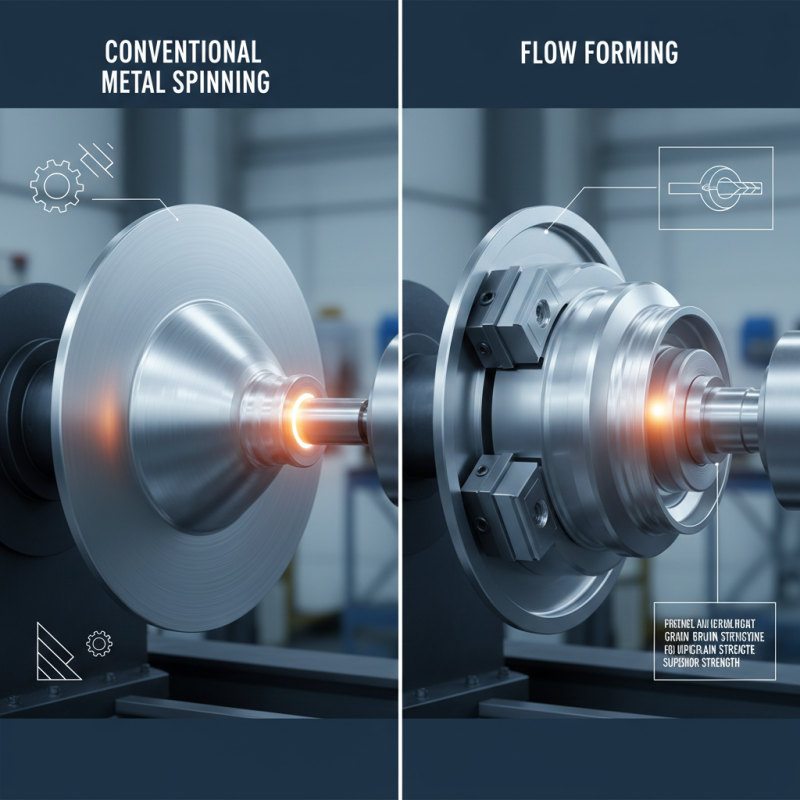
When comparing metal spinning and flow forming, tooling and setup play crucial roles. Metal spinning requires specialized tooling, including a mandrel and various tools to shape the material. The setup can be time-consuming as the operator must ensure the workpiece is secured and aligned properly. This process often involves multiple adjustments, which can introduce inconsistencies if not executed carefully. Relying on precision is essential.
Flow forming, on the other hand, utilizes a different approach. The tooling used in flow forming is often simpler and more straightforward. It requires a die that shapes the material while it is rotated. This setup can be quicker, but it still demands high precision. If the setup is not optimal, it can lead to defects in the final product. Operators must be aware of the material properties to avoid complications during the process.
Both methods have their unique challenges in tooling and setup. Understanding these nuances is essential for achieving high-quality results. In practice, operators must always reflect on their setups and be ready to make adjustments. This adaptability can significantly influence the efficiency and quality of production in both metal spinning and flow forming processes.
: Metal spinning requires specialized tooling like a mandrel. Flow forming has simpler dies.
Metal spinning setup is time-consuming due to multiple adjustments. Flow forming setup is quicker but also needs precision.
Metal spinning allows for rapid prototyping. Quick adjustments can lead to faster turnaround times.
Yes, flow forming produces parts consistently at high speeds. It excels in creating complex shapes accurately.
Metal spinning is cost-effective for small runs due to lower tooling costs. Flow forming is better for larger volumes over time.
Yes, if the setup isn't optimal, defects can occur. Precision is crucial to avoid complications.
Operators need to ensure workpieces are secured and aligned properly. Reflection on setups can enhance quality.
Adaptability allows operators to make adjustments quickly. This influences production efficiency and quality significantly.
Metal spinning often saves on material costs. Flow forming can produce more components but may require more raw materials initially.
The article titled "China Top 10 Differences Between Metal Spinning and Flow Forming" explores the distinct features between these two manufacturing techniques. One key focus is on the tooling and setup processes, highlighting how metal spinning often requires simpler tools compared to flow forming, which can be more complex. Additionally, the discussion includes material thickness considerations, where metal spinning can accommodate a wider range of thicknesses with ease.
When comparing production speed, the article emphasizes that each method has its advantages, with flow forming being typically more efficient for high-volume production. Cost implications are also examined, revealing that metal spinning can be more cost-effective for smaller production runs. Finally, the article outlines various applications and use cases across different industries, illustrating the contexts in which manufacturers prefer each technique. Understanding these elements helps answer the question: what is the difference between conventional metal spinning and flow forming?

 ZRF Spinning